Winter Arc Meaning, Rules, and How to Do One for Your Head
A winter arc is a stretch of the cold months, usually October 1 to January 1, given to one deliberate push on yourself, so you come out of winter changed instead of having waited it out. There are no official rules. Most people fill theirs with the gym, early alarms and no alcohol, which reaches the body. The part of winter that wears people down is in the head: the 2 a.m. loop, the sense of being behind. You can run a winter arc on that instead.
What is a winter arc?
The name comes from anime. A training arc is the part of the story where the hero goes away, trains through a hard season and comes back a different character. On TikTok, where it became the winter arc challenge, that turned into a plan for the last quarter of the year: change something while it is cold and dark and the usual excuse is to wait for January, and arrive at New Year already moving. The common version runs October 1 to January 1, ninety days; a shorter one starts November 1 and runs sixty. The point is that winter is the season most people write off, and an arc is the decision not to.
What are the winter arc rules?
There is no official list; you write your own. But the lists that go around look alike: up at 5 or 6, gym or 10,000 steps, protein at every meal, no alcohol, ten pages of a book, no phone for the first half hour, bed by 10:30, cold showers for the brave.
All of that is for the body, and none of it is bad. The trouble is what the list does to a head that is already running hot. All-or-nothing is built in: a missed alarm is a failed day, a failed day is a failed arc, and by November the only people still posting are the ones it suited anyway. A better test for any rule: could you keep it up for six months? If not, it will not survive to January either. And the arc in the stories is spent alone on a mountain; going quiet on your friends for three months is the one rule that reliably makes a winter worse.
So here is the other list, for the part of you that lies awake.
| The usual winter arc | The quiet winter arc |
|---|---|
| Before photo in the mirror | Before page: how you feel today, dated |
| 5 a.m. alarm | 6 p.m. worry hour, fifteen minutes |
| Gym three to five times a week | Twenty-minute walk, nothing in your ears |
| No sugar, no alcohol | Mute five accounts that make you feel behind |
| Habit tracker, do not break the streak | One colored square a day, nothing to break |
| Rest day | Rest day. Same rule, kept this time |
How do you do a winter arc for your head?
Six rules. About an hour a week between them, no alarm, and each leaves something to look at in January.
1. Take the before photo in words. Tonight, write how you feel today. Not goals, just what is heavy and what you are quietly hoping for. Date it and keep it for New Year's Eve. Memory edits: in a Science study of more than 19,000 people, Quoidbach, Gilbert and Wilson found that at every age people felt they had changed a lot up to now and expected to change little from here on. In December you will not believe how different November felt. The page will know. If paper never lasts with you, say it to Flamy in Cave instead: it keeps what you tell it by topic, so in late December you can read what November-you thought about work, or about that one person, and Flamy can ask what changed.

2. Give worry an appointment. Pick a time, say 6 p.m., and a place, and give your worries fifteen minutes there every day. When one shows up at 2 a.m., the answer is not "stop it" but "not now, you have a slot." Psychologists have tested this since 1983, and a 2024 meta-analysis of seven randomized trials, 999 people in all, found that a week to a month of it made people worry less often and for less time. The studied version is thirty minutes; the effect is modest but real. At six, think the worries through rather than feel them again. Most look smaller by then; how to stop overthinking covers the ones that do not, and a worry that has been costing you sleep for weeks deserves a professional, not a slot. Fifteen minutes of saying it out loud to Flamy is a fair worry hour too: it takes the vent, asks the next question, and may point out that this one came up in October as well, which is usually when a worry turns into a decision.

3. Walk twenty minutes with nothing in your ears. No podcast, no call, no music. The first few are uncomfortable, and that is normal: in Timothy Wilson's studies at the University of Virginia, many people chose a mild electric shock over fifteen minutes alone with their thoughts. That is how out of practice we are, not a sign the walk is wrong. Let a thought run to the end for once. By the third or fourth walk you start hearing yourself again, and a park beats a main road if you have the choice.

4. Mute five accounts that make you feel behind. Yes, the 5 a.m. ones especially. They are made to inspire, and some do. But in Tiggemann and Zaccardo's experiment, women shown fitness inspiration images came away in a worse mood and less happy with their bodies than women shown travel photos, and the damage ran through comparison: you watch, you measure yourself, you lose. The test for each account: after you watch, do you move, or do you feel smaller? Mute, not unfollow. You can unmute in spring.
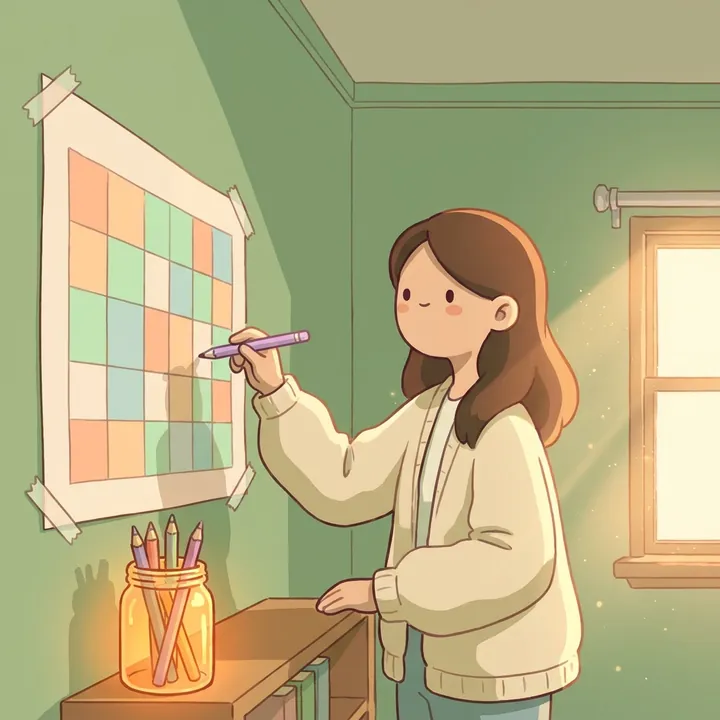
5. Color one square a day. Draw a grid of sixty or ninety squares, one color per kind of day, and fill one each night. Ten seconds. It is not a streak: an empty square is information, not a failure. By January you see your winter in one glance, and the bad days usually cluster, around a person, a weekday, the nights after the calls home. That pattern is worth more than any rule on the list. Cave paints a version of this on its own: every week you have talked with Flamy becomes an illustrated highlight, so by January the winter is there to look at without drawing it.
6. Keep a rest day. One evening a week with no plans and no guilt about it. Every training arc in the stories has them, and every gym program does; only the self-improvement version forgot. It is also where you decide what a missed day means: the floor version tomorrow, nothing else. How to be consistent covers the day after the miss.
On New Year's Eve, read the before page. Then write the next one, and your resolutions will come from a record of the winter instead of the mood of the night.
FAQ
What does winter arc mean?
A winter arc is a self-set period of focused effort over the cold months, usually October 1 to January 1, to come out of winter changed. The name comes from anime training arcs, where a character goes away to train and returns transformed. It spread on TikTok as a fitness challenge, but there are no official rules, and the goals can be about your mind as much as your body.
When does the winter arc start and end?
Most people start on October 1 and finish on January 1, about 90 days. A shorter version starts November 1 and runs 60 days, and some carry theirs to the spring equinox. The dates are a convention. What matters is a fixed end date, because a finish line is what turns a vague winter into an arc you can look back on.
Is it too late to start a winter arc in November or December?
No. The 60-day version from November 1 is standard, and a 30-day arc in December still gives you something to read on New Year's Eve. If you started in October and fell off, the arc did not end on the missed day; it ends when you decide the miss was the story. Write the before page tonight, pick two rules rather than six, and count from today.
How do you track a winter arc without a streak app?
Record how the days felt rather than what you ticked off: one colored square a day on a paper grid, or a few lines about the day. Cave does this through conversation: you talk to Flamy, it keeps a memory organized by topic that you can open and read, and each week becomes an illustrated highlight, so by January the whole winter is there to look at. Your memory is yours, and it is never used for training.