Left on Read: What It Means and What to Do While You Wait
Left on read means the person opened your message and has not replied. That is everything the phrase states for certain: the receipt proves the message was seen, nothing more. Whether the silence means anything depends on how fast this person usually answers you and on what you sent, not on how long the wait feels. Two quiet hours is nothing from someone who replies the next morning, and a real pause from someone who usually replies in minutes.
What does left on read mean?
The phrase exists because of read receipts: the "Read" under an iMessage, the blue ticks on WhatsApp, the "Seen" on Instagram. Apple added receipts to texts in 2011, the phrase was in Urban Dictionary by 2016, and by 2017 it was dating vocabulary. Its sibling, "left on delivered", means the message arrived but was never opened. Without a receipt, no reply yet is a non-event. With one, no reply looks like a decision somebody made while looking at your words.
That is already more than the receipt says. It records one thing: the message was opened. Not whether it was read properly, glanced at on the lock screen, or opened mid-conversation with someone else and buried under the next notification. Everything you "know" beyond that is supplied by you.
Why does being left on read hurt so much?
Two findings explain the evening better than any theory about the other person.
First, silence alone does the damage. In a study by Anita Smith and Kipling Williams, forty students texted with two other people, and for half of them the other two answered nothing for eight minutes. Belonging, self-esteem and mood all dropped, although nobody had told them they were being ignored on purpose; they could just as easily have blamed the phones. Eight minutes, strangers, a plausible glitch, and the reaction still came. It does not wait for a verdict; it fires on the gap, the same early alarm that drives fear of rejection.
Second, the receipt speeds it up. Yuuki Kato, Shogo Kato and colleagues asked several hundred Japanese students how long they wait for a reply before sadness, anxiety or anger set in. The feelings arrived sooner when the message showed as read than when it showed as unread, and sooner still in people who text a lot. An unread message leaves a door open: they have not seen it. A read one closes it, so the mind goes looking for a reason, and at this hour every reason on offer is about you.
So the size of the feeling is mostly a fact about the receipt and the clock, not yet a fact about the person.
Does being left on read mean they are not interested?
One unanswered message says almost nothing. A pattern says a lot. Three things tell them apart.
Their pace, not yours. Yoram Kalman and colleagues analysed more than 150,000 replies across work email, student forums and a question-and-answer site. Most came within the replier's own average, almost none took longer than ten times it, and past that the authors call it silence. Someone who normally answers you in ten minutes and has gone two hours quiet is doing something unusual. Someone who normally answers the next morning has not done anything yet. Measure the gap against their record, not against the clock.
What you sent. Read it once for this and once only: did it ask anything? "Haha yeah, same" does not need an answer, and a lot of messages people wait on were statements. If yours was not a question, you may be waiting for a reply to nothing.
What you do yourself. You have left someone on read this month, and the reason was boring: a call came in, you meant to reply properly, then it was late. When it is done to you, only the reasons about you remain. The boring one is usually right in both directions.
If the quiet is your partner's, after a conversation that did not land, it is a different silence: the conversation carrying on without words, with its own overthinking attached. Once you have both said your piece and it still has not landed, Cave Couples lets you both talk to the same Flamy, which hears both sides and can carry what you meant across better than a late follow-up text.
Weeks of this, with one-line replies when they do come, is an answer worth hearing. One evening is not, so the question is what to do with the evening.
What do you do while you wait for a reply?
The evening is the part you can actually fix. Five things for it.
- Put the phone in another room. Not face down, not on silent: in another room. Adrian Ward and colleagues tested nearly 800 people on attention tasks with their phones on the desk, in a bag, or in another room; the phone on the desk cost attention even when it was off and face down, and out of the room was best. Nobody types faster because you are watching. If you need a rule, check once an hour.

- Read your last message as if a friend had sent it to you. Ethan Kross's work on self-distancing shows that looking at your own situation the way you would look at a friend's cools it down. So: if that message had arrived on your phone from someone you like, would you panic? You would think "nice" and answer when you got to it. Nothing in it is a problem.
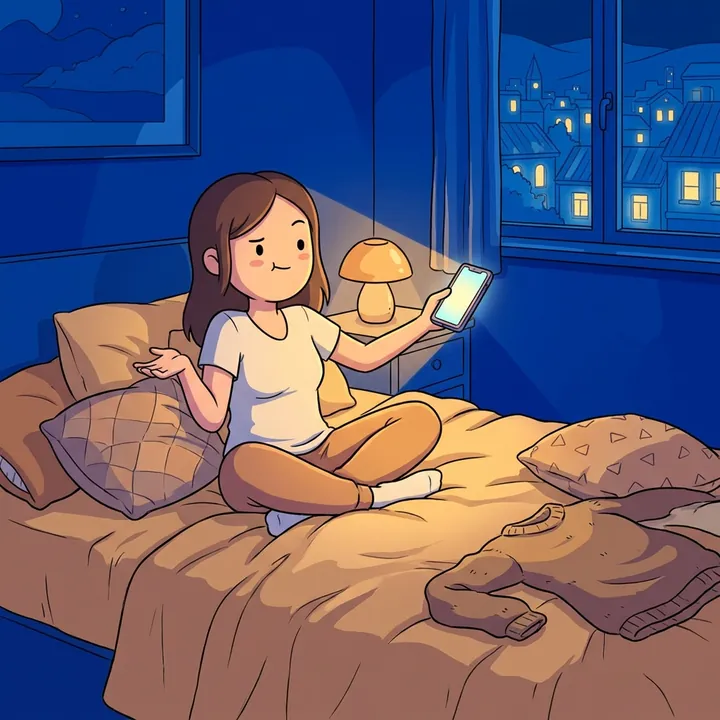
- Write the two endings. On one note, what you will say if they reply tomorrow. On another, what you will do if they never reply. Short and specific: "then I'll suggest Thursday" and "then I'll stop initiating and see who I actually feel like texting". The second note is the one you have been avoiding, and writing it is how you find out it is a Tuesday you could live through, not a cliff. Once both exist, tonight has nothing left to decide.

- Make the plan anyway. If their reply was going to settle your Friday, settle it yourself. Book the thing, ask someone else along, or go alone. A message on read is not a no; it is a not yet, and a not yet does not get to hold your week.

- Nothing after midnight, yours or theirs. A 2022 review by Andrew Tubbs and colleagues, The Mind After Midnight, describes how a brain awake late at night tilts towards negative mood and impulsive decisions. It is about far heavier things than texting, but the same tilt writes "ok so I guess you're ignoring me" at 1 a.m. and regrets it at 9. If it still needs saying in daylight, say it then. Leave the phone charging across the room.

None of these covers the need to say it all to someone. A friend works, if this is not the third time this month. Cave is for when it is. You tell Flamy, a small flame you message or call, the ten o'clock version in full, and it behaves like a good friend rather than a cheerleader: takes it, asks what you would actually want them to say back, maybe asks whether you have told anyone in person. Because what you tell it stays as memory organised by topic, it can also point out that this is the third evening since September spent waiting on the same person. That is the thing you cannot see from inside one evening, and the point where venting turns into something you can look at. Some nights you only needed to say it, and that is fine too. It is not therapy.
FAQ
What does it mean when someone leaves you on read?
It means they opened your message and have not replied yet. That is all the read receipt tells you. Whether it means more depends on how fast this person usually answers you, whether your message asked anything, and whether this is a pattern. One quiet evening is not information. Weeks of short replies and long gaps are, and that is when it starts to look like ghosting rather than a busy night.
How long should you wait before texting again?
Measure against their usual pace, not the clock: anything inside their normal reply time is not a delay at all. Past roughly a day, one light follow-up is fine, ideally with something easy to answer in it ("still on for Thursday?"). After that, the next message is theirs. Two or three follow-ups in a row say more about your evening than about anything you meant to tell them.
What can I do with the waiting besides checking my phone?
Say it somewhere that keeps it. In Cave you tell Flamy the whole ten o'clock version, it asks what you would actually want to hear back, and the evening stays as memory you can open later, organised by topic. If the same person has had three of your evenings this month, it can tell you, which is the part you cannot see on the night. Your memory is yours and is never used to train AI models.